Teaching the Beginner Hockey Player
Okay, I have to start with a huge smile here, because I’ve just finished browsing through some old notes reflecting back on what I’d call — for the lack of a better name — a “tryout” I ran a few years back for a new 5- and 6-year old team coming from my winter Learn-to-skate/Learn-to-play program. Ya, they were an adorable lot, with a 4-year old even being one of our better little guys.
Anyway, for the sake of those who might be involved with a similar kind of team or clinic right now, I thought I’d share some of my thoughts, as well as some of the “drills” I chose to use…
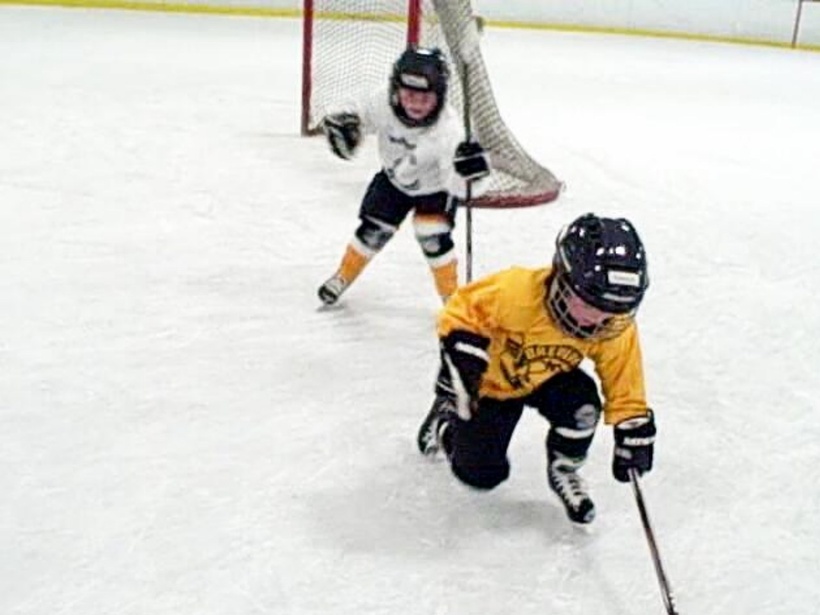
Now, it shouldn’t surprise you at all that almost all of what I’ll share here can already be found elsewhere within this site. The reason is that I really DO practice what I preach. I mean, if I’ve said, “This is how we should teach _______,” it’s because that’s what I’ve found over 45-ish years will really work. And I don’t care if it has to do with beginners or elite level players; that’s how I’d do it.
As far as “my babies” go, I told a few of their parents beforehand that it wouldn’t take more than a few minutes to get a sense of whether a youngster belongs on that team. In a way — and not much different from older kids, most of us can usually spot a hockey player as he or she comes out the door. There’s just something about the way he or she carries himself or herself.
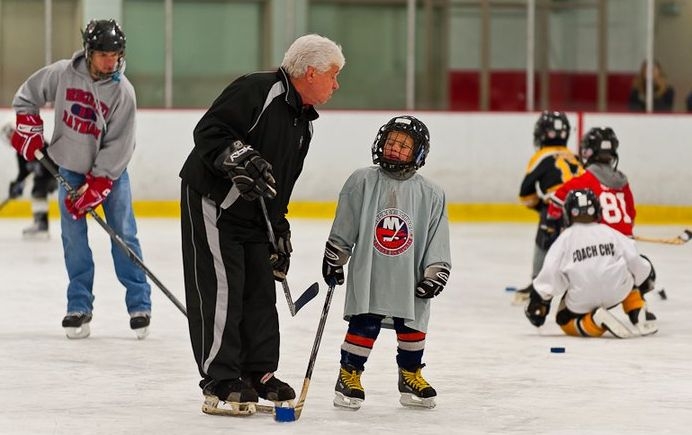
Of course, it might take a drill or two more to gain a sense of whether a very young one is ready to take a few instructions. Understand that I was only going to start planting the seeds in that first gathering. In a way, I wanted to get a head start on some things I’d want the kids to ultimately learn. But I also knew that those kinds of drills would actually give me an idea of whether those kids — at their young ages — could focus and understand some verbal instructions and my brief demonstrations.
Now, here’s what guided me in my drill selection…
- The younger players are, the more malleable they are, and the more a really good “teacher” can influence them.
- Defensive play may be a factor in the kids’ success down the road. Sure, there might eventually be a time when youngsters can start appreciating a forechecking scheme, different kinds of coverages, etc.
- But, right then the only thing that would really capture my little guys’ attention and enthusiasm — and probably the only thing they could really understand — was offense, as in scoring goals.
That in mind, I grabbed a number of ideas from my “Creating the Early Goal-scorer” video (and you might also scan “The Idea(s) Behind Those Goal-scoring Gadgets“).
Of course, my youngsters were true beginners at the game, which made them slightly less experienced than the players I was really aiming to help in that video. So, while I did try a few of the ideas demonstrated there, I had to use another important teaching technique I’ve mentioned a few times elsewhere. I mean, what I had to do was create some even easier to do lead-up progressions to start easing my new kids towards the more difficult skills.
Remember: really young ones aren’t into too much structure or discipline. So I started things by tossing pucks out onto the ice and encouraging the kids to just have some fun.
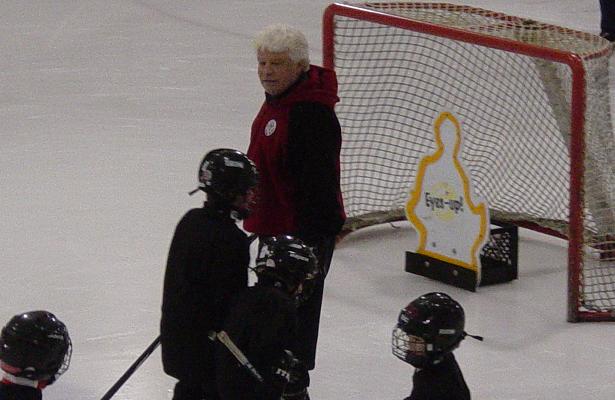
Also remember that, since these WERE really young ones, it wasn’t right for me to immediately talk to them like older players. So, I quite often during that first session called them into a little group by announcing, “Okay, kids, let’s have a really important meeting here.” And, getting them on their knees and focused (for about the 20-seconds their attention spans would allow), I frequently started with some kind of question — maybe about the row of pylons we were going to attack, or about the “simulated goaltender” sitting in front of the net.
I also loosely applied the Whole: Part Method of structuring drills… As examples, each little guy got to attack the make-believe goalie in one drill, we had 2-player-races towards that goalie — this to encourage more speed in their attack, we practiced going in and out of pylons (which I referred to as “the bad guys”), and at one point we played a simple game of keepaway with a puck. At the end of the morning session, I put a couple of the earlier practiced “parts” together by having the kids — one boy at a time — weave in and out of the pylons at a decent speed, and end by scoring on that simulated netminder.
Oh, and you know my penchant for taking notes… So, at one point during that session I jotted to myself to sometime later bring some weights to a future practice. The ideas was to use them for strengthening the kids’ stick grips, passes and shots. (What I planned on doing with the weights can be found in my “Passing Basics in Hockey“ video.)
Finally, at one point during our session — while the kids were playing keepaway, I mentioned something important to two dads who were out on the ice helping… Both dads had themselves played to pretty high levels, so I thought it a good idea to share the distinctions I was seeing. Or, as I said while we watched the keepaways going on, “That’s really what THEIR game is all about, you know.” And I went on to suggest that it’s not about the leftwing lock, defensive zone coverage or a powerplay. No, THEIR game is about getting the puck and keeping it away from their opponents. It’s about weaving in and out of those “bad guys”, and it’s about beating a little goalie who is usually no more agile than the plastic one we’ll use at our practices.
And, as I’ve also said at numerous times in these pages, our job — as parents and coaches — is to help our youngsters be successful at THEIR level.
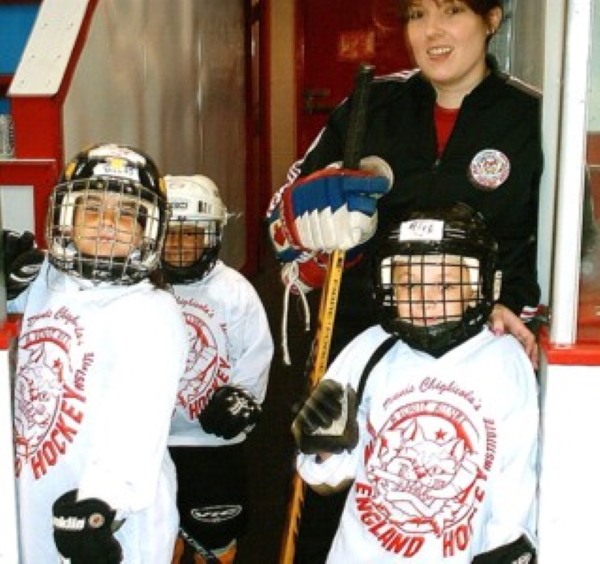
Now, before ending I have to say that there’s yet another reason I was smiling — or even chuckling — as I reflected on that long ago tryout session. For, as I noted above, these “babies” are as malleable as players can be, and they can be changed rather quickly under the guidance of a really good teaching coach. And while I have a strong belief in my own abilities, I also know I can almost triple our teaching efforts by helping my assistants to be nearly as effective.
Oh, my reason for chuckling? It’s because I could only imagine at the time what our games were going to be like later — when every single youngster on our team was able to stickhandle through their opponents and coolly tuck the puck into their opponents’ nets. Oh, boy… I couldn’t wait to begin creating some hockey monsters!
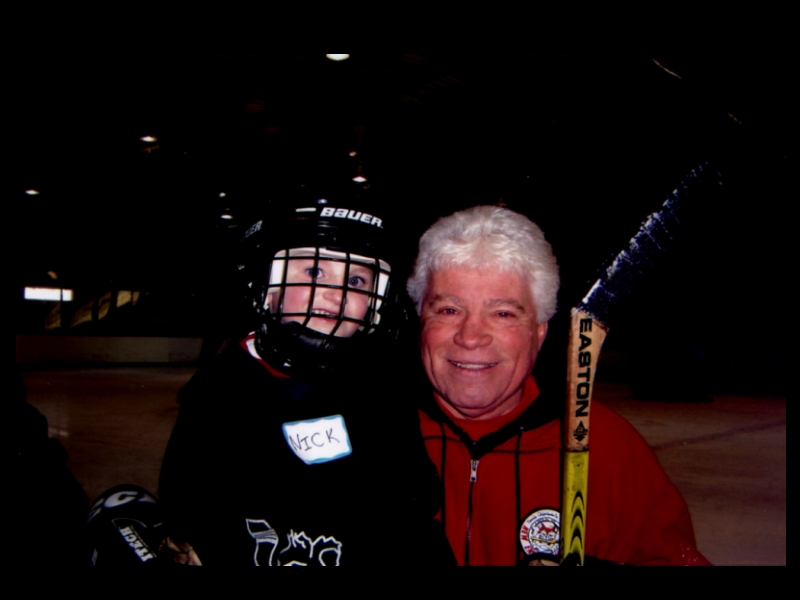

His sister is 15, playing hockey for 6-7 years, who is offf to Madison Capitals Spring practice right now.
I’m kinda hoping an article like that, Tom — along with my thought process, will help dads like you with new little ones coming along. I also hope you’ll fire some questions my way and give me some new things to think about.
Wonderful. I am about to start soccer and hockey with 4 year old grandson, who has slow speech development. But improving.