Where Do Hockey Drills Come From?
July 26, 2009 by Dennis Chighisola
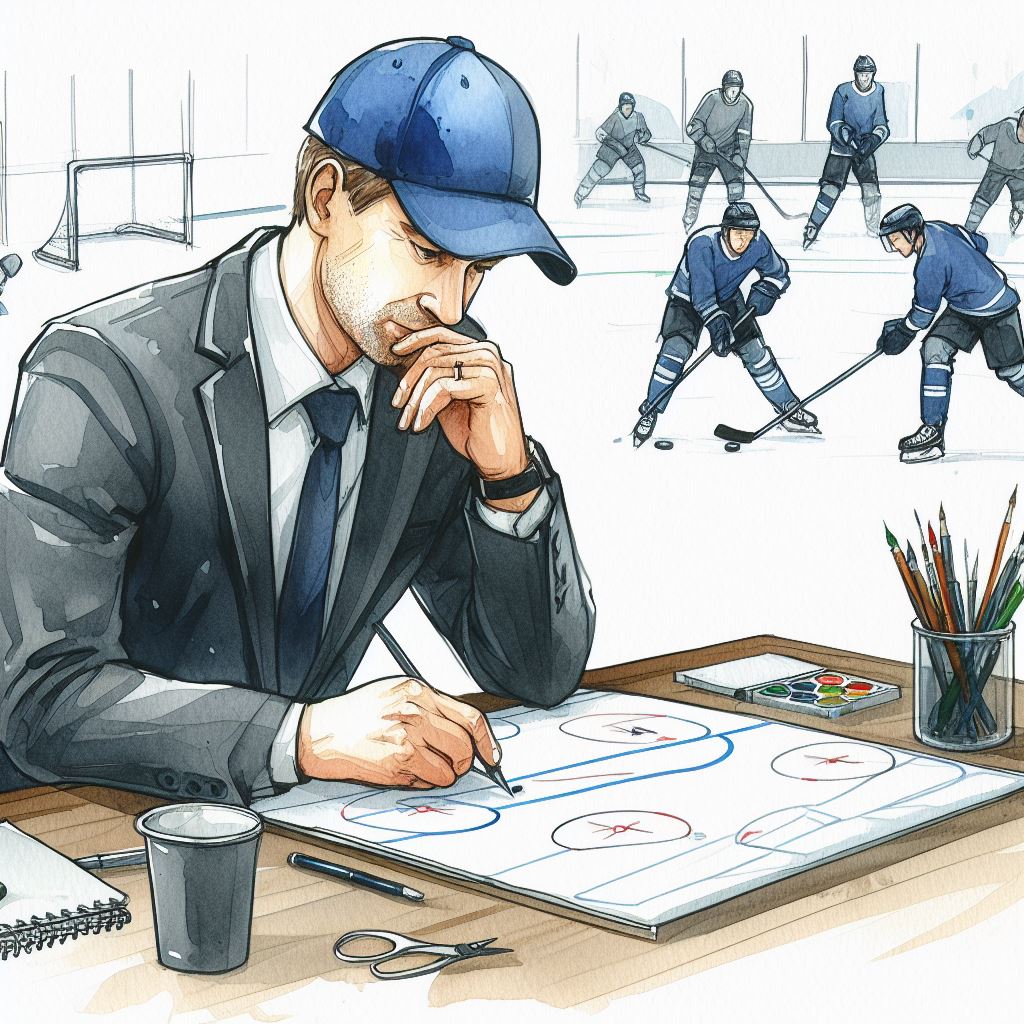
It must have been about 2- or 3-years ago when one of my Team NEHI assistants described something he’d seen on a newscast. I guess the sports segment showed some clips of our local NHL hockey team, and then it highlighted the team’s new coach. As my friend excitedly explained, the guy was being lauded by his players, mainly because of the way he made practices fun and interesting. And I guess that pro coach was also credited with inventing a number of his own drills, including one my assistant saw and marveled at.
Now, I’m taking this all in, and I’m sort of smiling on the inside (hey, maybe I was even grinning on the outside). No matter, I ultimately shared with my assistant the fact that I create drills all the time. (More recently I’ve stated that I probably invent pretty close to a drill per week, although sometimes it’s only a drill per month.)
What I think really amazed my friend was the fact that anyone could just up and design a new drill — be it that NHL guy, yours truly, or anyone else.
Anyway, we were interrupted before too long, so I had to leave-off with a simple enough question, “Where do you think drills come from?”
That, of course, gives you and me a place to begin. And, it also provides the opportunity for some spin-off examples this month, most notably in an entry whereby Todd Jacobson explains some drills he’s currently using with our Team NEHI goaltenders.
– Dennis Chighisola
Now, from this old coach’s perspective, new drill ideas frequently come about because there’s a problem. Said yet another way, a new drill can be created to solve a difficulty one of our players — or most of our team — is experiencing.
New drills are also often devised to enhance a given individual skill. In other words, we might invent a new skating drill because it will enhance that area for a player (or numerous players), and we could do the same to help him, her or them to be better puckhandlers, passers, receivers, shooters, checkers, etc.
For sure, long-time members know that I find a huge benefit to borrowing from other sports. So, for example, I might study what high level sprint coaches are doing with their athletes, and subsequently adapt a drill or two that translates well to my guys’ work on skating speed. I’ve further helped my players by borrowing footwork drills or ball handling drills from other team sports, I’ve found some tactical or strategy ideas in other sports that actually work well in hockey, and I’ve discovered plenty of conditioning or competitive type drills that are useful and appropriate for my use (so long as they meet the demands placed on ice hockey players).
I’m especially on the look-out for new training aid ideas. Let’s face it: Players love pitting their efforts against gadgets, and they’ll often go above and beyond their normal practice pace just to beat one. Of course, cost is a factor with these — for all of us. So, while I might purchase some training devices, I might be able to arrive at a homemade version that does the trick nicely, or I might be able to borrow from just the main concept of a great tool to achieve fairly similar training effects in another way. (That might be the case with the first drill Todd introduces this month.)
An improvement in team play skills frequently calls for the use of an important principle of motor learning known as the Whole:Part Method (and so can this method be used to break-down and improve a rather complex individual skill). As with other technical terms I use within these pages, have no fear; I’ll make it simple enough for anyone to understand…
A good example of this technique might be the breaking-down of a basic breakout play. And in this example, the breakout represents our Whole. Of course, something like passes exchanged — perhaps from a defenseman to a near winger to a centerman — will either work or not work, depending on execution. So, this important motor learning principle suggests that each of the small Parts of a breakout could be practiced, vastly improved, and then put back together into a more efficient Whole. That was the basis for my video on Basic Breakouts. However, as you’ll notice in that video, I’ve gone quite a bit deeper, focusing on the goalie’s involvement and in his or her handling of the puck, a defenseman’s moves with a puck to avoid a forechecker, improved pass-receiving routes by the forwards, etc. And one could get deeper and deeper into each tiny element of that play. In fact, a coach (player or parent) could view just one of those examples as a Whole, break it down into smaller Parts, perfect those Parts, and then put them back together into a more proficient Whole.
Now, I’ll tell you how I often arrive at some of my new drill ideas — actually applying the about principle…
Please click-on this link for A New Hockey Drill Idea, then look over my shoulder to see a segment of video I’ve isolated on, or the Part I’m running over and over again.
As you might notice, the breakout is actually botched, and a defensive player coming down the middle intercepts the pass.
Something struck me about that play, causing me to make a drill out of the interception and the immediate problem faced by the puckcarrier. In other words, he grabs the puck, and then quickly finds a defender right in his face. (If you need to watch the video a number of times to see what I’m getting at, please do so. Can you see how constantly re-running a short segment does sort of look like a drill?)
And that’s the new drill I’m going to soon put into my practices… I’m going to place a line of forwards out near their offensive blue line, and I’m going to have another line of defenders ready off to one side. As a coach tosses a free puck out in the vicinity of the first forward, he’ll quickly be pressured by the first guy in the defenders’ line. To me, this is something that happens in a game, or something my puckcarriers frequently have to deal with. So, why not practice it?
Oh, by the way… I can already see potential for progressions to this drill. As happened in the video, the guy who intercepted the pass was quickly joined by a teammate. So, I’ll eventually do the same in the next step to this drill, having a second forward exit the line to — as quickly as possible — join the attack.
Just as an FYI here… I honestly did just create this drill as I was preparing the current entry for you. I grabbed the first game footage I could find, I ran it a number of times, and that interception kept jumping out at me.
Now, this entry happens to introduce two things I’d like to continue for awhile here at CoachChic.com.
The ability to open some of our videos in a new window is going to help me rush certain information to you. In other words, rather than needing to spend the hours required to put an audio soundtrack to short clips that require only brief explanations, I can quickly shoot the video, upload it to a post for you to see, and do my explaining via the nearby text. (Let me know if this works or doesn’t work for you, but the ability to do this is likely to mean tons more video for you.)
Finally, I know lots of members want me to do ALL of the work for them, including showing them EXACTLY how a drill should be run. Oh, I’ll continue to do plenty of that. At the same time, though, I sense I’m arming you all the more if I explain and show how you might either design your own drills, or slightly adapt other drills to better suit your specific needs. (No, none of us are likely dealing with the exact same problems or talents, so it’s helpful that we have a sense of how to create some of our own drills.) So, over coming days, weeks and months, look for more ideas in this area. I’m getting psyched!Â
![]()
– Dennis Chighisola


Comments
Feel free to leave a comment...
and oh, if you want a pic to show with your comment, go get a gravatar!